 EN
EN 



 Post by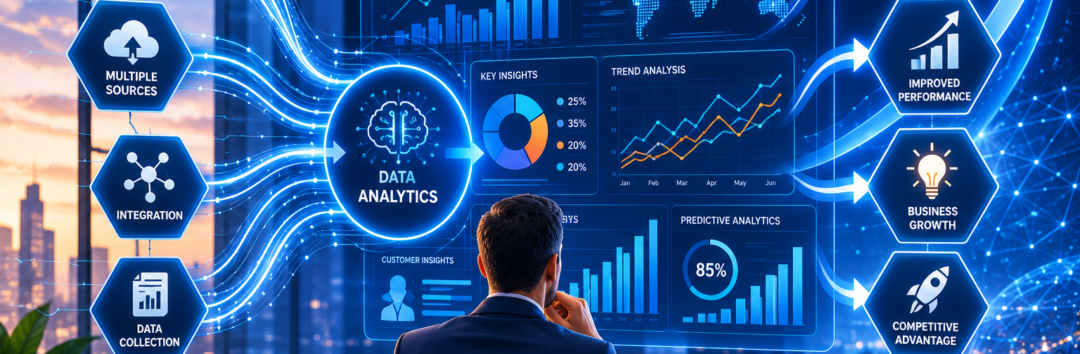
Introduction
In today’s digital-first world, data has become one of the most valuable assets for businesses. Every customer interaction, transaction, and business process generates valuable information that can help organizations make smarter decisions. However, raw data alone has little value unless it is analyzed and transformed into meaningful insights. This is where Data Analytics plays a crucial role.
Data Analytics empowers businesses to uncover trends, predict future outcomes, optimize operations, and improve customer experiences. By leveraging modern analytical tools and technologies, organizations can gain a competitive advantage, identify new opportunities, and make informed decisions that drive sustainable growth.
What is Data Analytics?
Data Analytics is the process of collecting, organizing, analyzing, and interpreting data to discover useful insights that support better business decisions. It combines statistical techniques, business intelligence, visualization tools, and advanced technologies such as Artificial Intelligence (AI) and Machine Learning (ML) to convert complex datasets into valuable information.
Organizations use Data Analytics to monitor performance, understand customer behavior, forecast market trends, optimize business operations, and reduce risks. It enables decision-makers to move beyond assumptions and base their strategies on real-time, data-driven insights.
Why Data Analytics Matters
Businesses today generate massive amounts of structured and unstructured data from websites, mobile applications, customer interactions, social media, and operational systems. Without effective analytics, valuable information often remains hidden.
Data Analytics helps organizations identify patterns, measure performance, improve efficiency, and respond quickly to changing market conditions. It enables leaders to make proactive decisions instead of reactive ones, helping businesses stay competitive in an increasingly data-driven economy.
Whether improving customer satisfaction, optimizing supply chains, increasing sales, or managing financial performance, data analytics provides the intelligence organizations need to achieve their business objectives.
Key Benefits of Data Analytics
1. Better Decision-Making
Access real-time insights and accurate reports that enable business leaders to make informed strategic decisions with confidence.
2. Improved Customer Experience
Analyze customer preferences, purchasing behavior, and feedback to deliver personalized products, services, and marketing campaigns.
3. Increased Operational Efficiency
Identify process inefficiencies, automate reporting, and optimize business operations to improve productivity and reduce costs.
4. Predictive Business Intelligence
Leverage predictive analytics to forecast trends, customer demand, and potential business risks before they occur.
5. Cost Reduction
Analyze operational data to identify waste, optimize resources, and improve overall financial performance.
6. Competitive Advantage
Gain deeper market insights, monitor industry trends, and make data-driven decisions faster than competitors.
Types of Data Analytics
Businesses utilize different types of analytics depending on their goals:
Descriptive Analytics
Summarizes historical data to understand past business performance.
Diagnostic Analytics
Identifies the root causes of business challenges and performance issues.
Predictive Analytics
Uses historical data and machine learning models to forecast future outcomes.
Prescriptive Analytics
Provides intelligent recommendations that help businesses determine the best course of action.
Together, these analytics approaches provide organizations with a comprehensive understanding of their operations and future opportunities.
Applications of Data Analytics Across Industries
Data Analytics is transforming organizations across multiple industries.
- Healthcare improves patient care through predictive diagnostics and healthcare analytics.
- Banking & Financial Services uses analytics for fraud detection, risk assessment, and customer insights.
- Retail & E-commerce optimizes inventory management, customer segmentation, and sales forecasting.
- Manufacturing improves production efficiency, quality control, and predictive maintenance.
- Telecommunications enhances network performance and customer retention strategies.
- Information Technology supports system monitoring, cybersecurity, and application performance optimization.
Every industry benefits from making informed decisions based on reliable data.
Emerging Trends in Data Analytics
As technology evolves, Data Analytics continues to become more intelligent and accessible.
Some of the latest trends include:
- Artificial Intelligence-Powered Analytics
- Machine Learning & Predictive Modeling
- Real-Time Data Analytics
- Self-Service Business Intelligence
- Cloud-Based Analytics Platforms
- Big Data Processing
- Data Visualization Dashboards
- Natural Language Querying
- Augmented Analytics
- Data Governance & Security
Organizations adopting these innovations gain deeper insights while improving agility and business performance.
How Ragrak Technologies Helps Businesses with Data Analytics
At Ragrak Technologies, we help organizations unlock the full value of their data through intelligent analytics solutions and business intelligence services. Our experienced team combines industry expertise with advanced technologies to transform complex data into actionable insights that support business growth and digital transformation.
Our Data Analytics services include:
- Business Intelligence & Reporting
- Data Visualization Dashboards
- Predictive Analytics
- Big Data Analytics
- Data Engineering
- Data Integration
- AI & Machine Learning Solutions
- Cloud Data Analytics
- Performance Monitoring
- Data Strategy & Consulting
We work closely with clients to develop customized analytics solutions that improve operational efficiency, strengthen decision-making, and create measurable business value.
The Future of Data Analytics
The future of Data Analytics lies in automation, Artificial Intelligence, cloud technologies, and real-time intelligence. Organizations will increasingly rely on advanced analytics to predict market changes, optimize operations, personalize customer experiences, and automate complex business decisions.
As data volumes continue to grow, businesses that invest in modern analytics platforms and skilled data professionals will be better positioned to innovate, adapt, and lead in an increasingly competitive marketplace.
Conclusion
Data Analytics has become an essential component of successful business strategy. By transforming raw data into meaningful insights, organizations can improve decision-making, optimize operations, enhance customer experiences, and identify new growth opportunities.
At Ragrak Technologies, we empower businesses with innovative Data Analytics solutions that turn information into competitive advantage. Whether you’re beginning your data journey or expanding enterprise-wide analytics capabilities, our experts are committed to helping you make smarter decisions and achieve long-term success.